

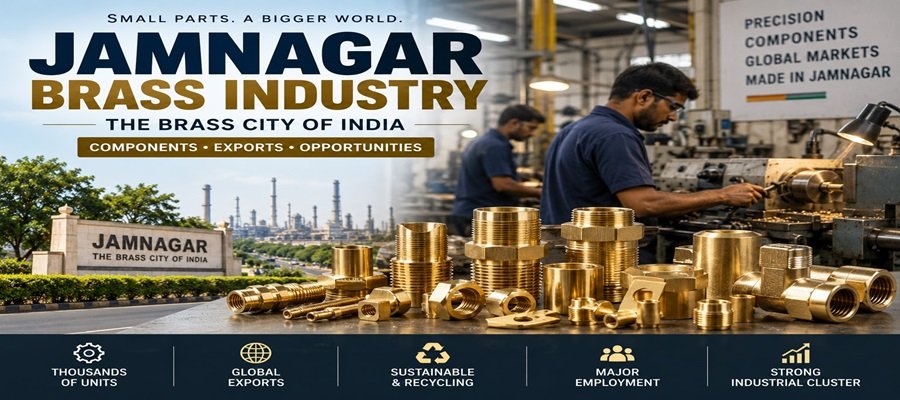
Jamnagar Brass Industry: 7 Facts About India’s Best Hub
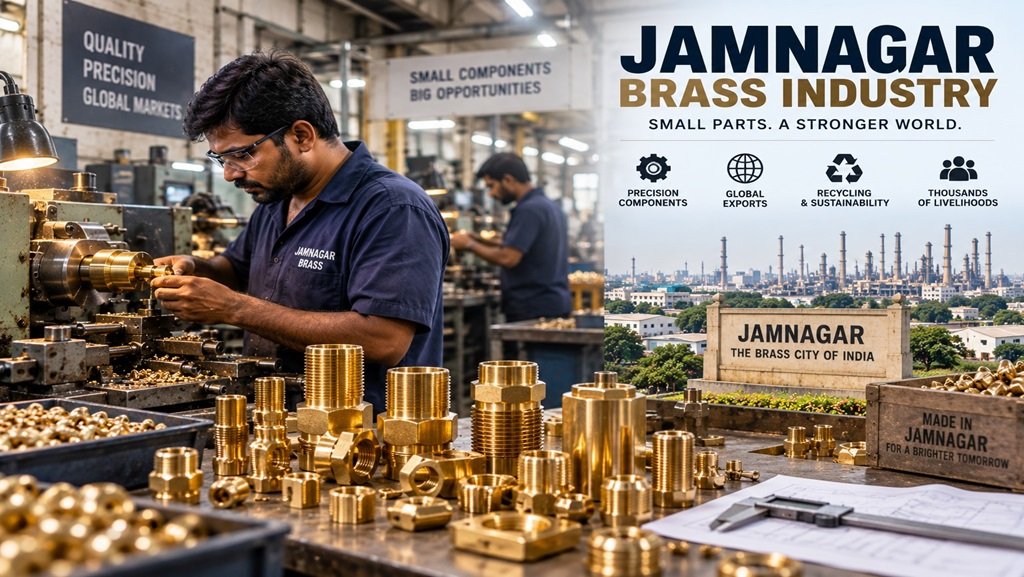
Inside Jamnagar’s brass manufacturing sector, where skilled workers produce precision brass components for domestic and global markets.Most visitors know Jamnagar for its lake, its temples and the refinery on the edge of town. Far fewer know that the Jamnagar brass industry is the reason this city appears in trade directories on four continents. This is the place much of the world buys its brass parts from.
What the Jamnagar Brass Industry Actually Makes
The output is not decorative brassware, which is what most people picture. The Jamnagar brass industry makes components: electrical terminals, cable glands, sanitary fittings, valve parts, threaded inserts, automotive connectors and fasteners. Small, precise, unglamorous pieces that end up inside products assembled somewhere else entirely.
That distinction is worth understanding, because it explains why the Jamnagar brass industry is invisible in the finished goods you own while still being essential to them.
Why the Cluster Works
Industry bodies commonly describe Jamnagar as home to several thousand brass units, most of them small workshops rather than large plants. That density is the whole point. A manufacturer needing casting, machining, plating and polishing can get all four within a few kilometres, from four different specialists, without shipping anything between cities.
This is what economists call a cluster, and it is the single biggest reason the Jamnagar brass industry competes with far larger operations abroad. No individual workshop here would survive alone. Together they undercut factories many times their size.
The Brass City of India
The nickname is not a tourism slogan. Jamnagar is genuinely called the brass city of India, and trade estimates consistently place the great majority of the country’s brass component exports in this one cluster. Published figures vary between sources and should be read as industry estimates rather than audited numbers, but the direction is not in dispute.
7 Jamnagar Brass Industry Facts Worth Knowing
- It is a components industry. Parts that go inside other products, not brassware you display.
- It is built from small units. Thousands of workshops rather than a handful of factories.
- Specialisation is extreme. A workshop may do nothing but one machining operation.
- Recycling is central. A large share of input is recycled brass scrap, not virgin metal.
- Exports drive it. The customer base is global, which is why quality standards are what they are.
- Employment is enormous by local standards. The cluster is a major reason people move here.
- It is old. This grew over generations, not through a single investment.
What the Brass Industry in Jamnagar Means Locally
The brass industry in jamnagar shapes the city more than the tourist sights do. It is why there is an industrial belt on the outskirts, why there is steady demand for machinists and toolmakers, and why the local economy holds up better than the city’s size would suggest. If you are considering work or business here, this is the sector to understand first.
If You Are Sourcing From Here
Buyers comparing suppliers usually weigh the Jamnagar brass industry against Chinese and Turkish producers. The honest position is that the jamnagar brass cluster competes on flexibility and small-batch capability rather than on the very largest volumes. If you need a modest quantity of a specific part, this is a strong option, because the cluster structure means somebody here almost certainly already makes something close to it.
Verify certifications and capability directly with any supplier. We list local businesses but we do not audit manufacturing claims, and no directory listing, ours included, is a substitute for your own due diligence.
Seeing It For Yourself
The workshops of the Jamnagar brass industry are working premises, not attractions, and most do not receive casual visitors. If you have a genuine commercial interest, approach a firm directly and arrange a visit. If you are simply curious, the industrial areas on the city’s edge give you a sense of the scale from the road.
For the city itself, its history and what else is worth seeing, start with our complete guide to Jamnagar. India’s Ministry of MSME publishes cluster development material covering industries of this kind, and the Government of Gujarat site carries state industrial policy.
Jamnagar Brass Industry: Common Questions
Why is Jamnagar called the brass city of India?
Because the great majority of the country’s brass component manufacturing and export is concentrated in this single cluster of thousands of small units.
What does the Jamnagar brass industry produce?
Components rather than finished brassware: electrical terminals, cable glands, sanitary and valve parts, threaded inserts and fasteners.
Is the brass industry in jamnagar export focused?
Yes. Exports are the main market, which is why international quality and certification standards matter so much to producers here.
Can visitors tour a brass workshop?
Not usually. These are working premises. Commercial visitors can arrange a visit directly with a firm.
Is jamnagar brass made from recycled metal?
A large share of the input is recycled scrap, which is one reason the cluster stays cost competitive.